
What Does a Brand Identity Package Include in Hobart?
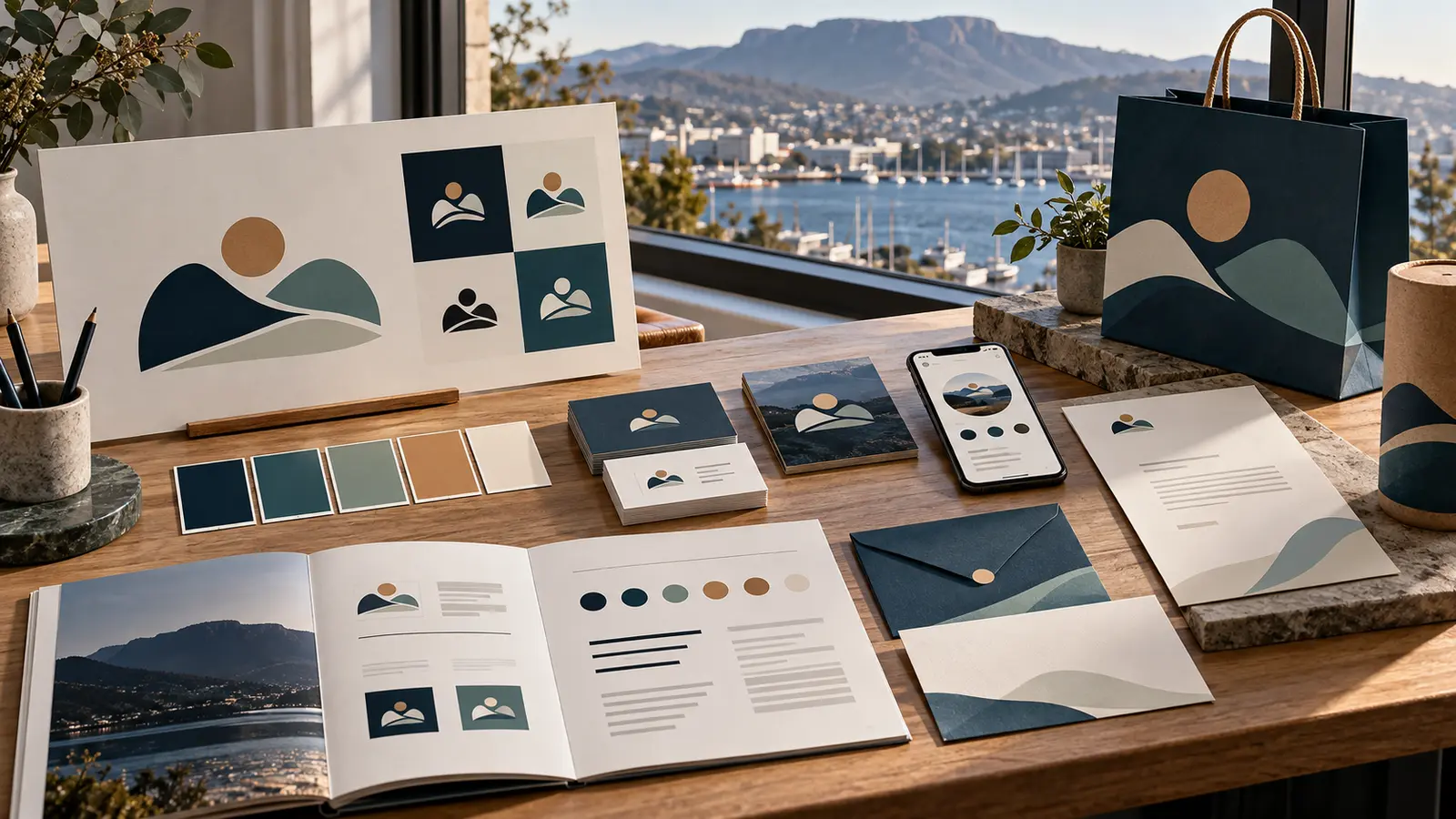
A useful brand identity package should include a clearly defined visual system—not just one logo file. At minimum, expect approved logo variations, a colour palette, typography choices, practical usage rules and production-ready files. The right package may also include stationery, social templates, signage, packaging or website examples, depending on where your Hobart business will use the identity.
The exact deliverables should follow the business problem. A new consultancy may need proposals, email signatures and a professional LinkedIn presence. A café may need menus, shopfront signs, packaging and delivery-platform graphics. Paying for a large bundle of unused mock-ups is no better than receiving a logo with no instructions. This guide explains what to ask for, what is optional and how to compare branding proposals fairly.
A brand identity is more than a logo
A logo is the recognisable mark or wordmark. A brand identity is the wider visual language that helps people recognise the same business across different places: colours, typography, imagery, layout, supporting shapes, icon style and rules for using them together.
That distinction matters when requesting quotes. A “logo package” may provide several logo files and little else. A “brand identity package” should explain how those assets work as one system. If the underlying business position, audience or name is also changing, read DanSol’s guide to choosing between a logo refresh and a full rebrand before deciding the scope.
Core brand identity package checklist
| Deliverable | What it should answer | Why it matters |
|---|---|---|
| Primary logo | What is the main approved mark? | Creates a consistent default |
| Logo variations | How does the mark work in narrow, square, small and one-colour spaces? | Prevents improvised versions |
| Colour palette | Which colours and digital/print values are approved? | Keeps production consistent |
| Typography | Which typefaces and hierarchy should be used? | Makes communication recognisable and readable |
| Supporting elements | Which patterns, shapes, icons or image treatments belong to the system? | Builds recognition beyond the logo |
| Brand guidelines | How should every element be used and avoided? | Helps staff and suppliers apply the identity correctly |
| Production files | Which editable, print and web formats are supplied? | Allows real-world use without repeated recreation |
| Application examples | How will the identity work on priority business touchpoints? | Tests the system before rollout |
A proposal does not need to use these exact labels, but it should define the deliverables and their intended use. “Complete branding” is not a measurable scope on its own.
1. Primary logo and responsive variations
The package should identify one primary logo and provide approved alternatives for spaces where the main version does not fit. Common variations include:
- Horizontal logo: useful for website headers, vehicles and wide signs.
- Stacked logo: suitable for square or more compact layouts.
- Brand mark or icon: for social profiles, favicons and small applications.
- Wordmark: the business name styled consistently without a separate symbol.
- One-colour versions: for stamps, embroidery, engraving and limited-colour printing.
- Reversed versions: designed for dark or photographic backgrounds.
Each variation should be intentionally drawn and approved. It should not be a supplier’s improvised crop of the main logo. Ask to see the smallest practical digital size and at least one black-and-white production test.
For more context on what a logo contributes to the broader system, see DanSol’s article on logo design and brand recognition in Hobart.
2. A usable colour system
A palette should name the primary, secondary and neutral colours and explain when each is used. Every approved colour needs the production values appropriate to the project:
- HEX and RGB for websites, apps, email and social media.
- CMYK for ordinary commercial printing.
- Pantone or other spot-colour references where exact colour matching is required and budgeted.
Ask how the palette behaves on light and dark backgrounds, in monochrome and in customer-facing interfaces. Brand colours do not automatically make text, buttons or forms accessible. W3C web accessibility design guidance recommends sufficient contrast for text, icons and interactive controls, and warns against using colour alone to communicate meaning. Logo artwork has specific WCAG exceptions, but the surrounding website and marketing interface still need readable combinations.
A useful package therefore includes approved accessible combinations for headings, body text, buttons and backgrounds—not only a row of attractive swatches.
3. Typography and hierarchy
Typography choices should cover more than the font used inside the logo. Ask for:
- a heading typeface and defined heading hierarchy;
- a body typeface suitable for longer reading;
- recommended weights and styles;
- fallback fonts for Microsoft Office, email and systems where the preferred typeface is unavailable;
- licensing information for desktop, web, app or commercial use; and
- examples of spacing, capitalisation and paragraph treatment.
A beautiful licensed typeface may be impractical if every staff member needs a separate licence or if it cannot be embedded on the website. Confirm ongoing costs and usage rights before approval.
4. Supporting graphics and image direction
A flexible identity usually needs visual elements that work when the logo should not dominate. These may include shapes, borders, patterns, illustration style, icon rules, photography direction or a consistent way to crop and colour images.
The package does not necessarily need a large photo library. It should, however, give enough direction for future work to look connected. For example, a Tasmanian tourism operator might define natural-light photography, wide landscape crops and a restrained palette. A professional service business might use clean diagrams, people-at-work imagery and generous white space.
When ongoing campaign, print or packaging work is required, DanSol’s graphic design services for Hobart businesses cover the applications that sit beyond the core identity system.
5. A practical brand guidelines document
Brand guidelines turn design decisions into repeatable instructions. A concise guide for a small business can be more useful than an impressive document nobody opens. It should cover:
- the approved logo set and when to use each version;
- minimum size and clear space around the logo;
- incorrect uses, such as stretching, recolouring or adding effects;
- colour values and approved combinations;
- typography hierarchy and fallback fonts;
- supporting graphics, image treatment and icon style;
- examples on the business’s priority applications; and
- a contact or approval process for unusual uses.
Ask whether the guide will be supplied as a shareable PDF and whether editable source files are included. Suppliers, new staff and franchise or partner locations should be able to apply it without relying on the original designer for every ordinary decision.
6. Production-ready files and ownership
Do not approve a package based only on presentation mock-ups. Confirm the final file set and who owns it.
Vector files
SVG, EPS, AI or PDF vector files allow a logo to scale cleanly for signs, vehicles and print. Ask which editable format will be supplied and whether it requires paid software.
Raster files
PNG files are useful when a transparent background is needed. JPG or WebP files may suit ordinary digital images. Request sensible sizes rather than one enormous file used everywhere.
Colour and background variations
The handover should identify RGB files for screens, CMYK files for print, one-colour artwork and reversed versions for dark backgrounds. Filenames should make each version obvious.
Rights and licences
The agreement should state who owns the final logo and supporting artwork, when rights transfer, whether the designer may display the work, and which third-party assets have separate licences. Also confirm access to editable files, not only exported images.
7. Priority applications for a Hobart business
Application design is where the system is tested. Select the items customers actually see rather than automatically buying every template offered.
- Professional services: proposal cover, report template, email signature, presentation slides and LinkedIn graphics.
- Hospitality: menus, shopfront sign, packaging, delivery tiles, uniforms and social posts.
- Trades: vehicle graphics, workwear, quote template, site sign and mobile-friendly website header.
- Retail: packaging, swing tags, shopping bags, window signage, product labels and ecommerce graphics.
- Tourism: booking-page graphics, itinerary template, wayfinding, brochures and partner listings.
Mock-ups are useful for testing and presentation, but ask whether the final files are genuinely ready for a printer, signwriter or web developer. A picture of a branded van is not the same as production artwork with measurements and supplier specifications.
What may cost extra?
These services can be valuable, but they should not be assumed unless they are listed:
- business naming, tagline development or brand architecture;
- customer, competitor or market research;
- brand voice and messaging;
- trade mark searching, legal advice or applications;
- custom photography, illustration or icon libraries;
- copywriting;
- website design or development;
- packaging production and regulatory information;
- signage measurements and print management;
- social template systems; and
- staff training or rollout support.
Separate essentials from optional applications. That makes proposals easier to compare and allows a staged rollout without weakening the core system.
Trade mark checks belong before expensive rollout
Registering a business name does not automatically give exclusive brand rights. IP Australia’s trade mark search guidance explains that Australian Trade Mark Search includes registered and pending trade marks and supports searches using words or images. It recommends looking for similar—not only identical—names, devices and slogans.
A designer can help create distinctive work, but legal clearance is a separate responsibility unless the proposal explicitly includes qualified advice. Complete appropriate checks before printing packaging, installing signs or launching nationally. If the business name itself is still being chosen, check business-name, domain and trade mark considerations together.
How the identity process should work
- Brief: define the audience, offer, goals, competitors, applications, constraints and decision-makers.
- Discovery: review the business, customer evidence and existing assets.
- Direction: agree on a strategic and visual direction before polishing logos.
- Concepts: review a defined number of considered options in realistic uses.
- Refinement: test the selected direction at different sizes, backgrounds and production methods.
- System design: finalise colours, typography, supporting elements and applications.
- Handover: receive organised files, guidelines, licences and ownership documentation.
- Rollout: update priority touchpoints and check that suppliers use the approved assets.
Request the number of concepts, revision rounds, meetings and included applications in writing. Unlimited revisions can sound reassuring but often indicate that the decision process is not clearly defined.
Questions to ask before accepting a quote
- Which deliverables are included, and which are examples only?
- Will the work begin with business and audience discovery?
- How many concepts and revision rounds are included?
- Which logo variations and file formats will I receive?
- Are font, image or illustration licences included or ongoing?
- Will I receive editable source files?
- Who owns the approved work and when do rights transfer?
- How will small-size, one-colour, digital and print uses be tested?
- Does the package include accessibility checks for digital colour combinations?
- Which real business applications will be designed and production-ready?
- What happens if a signwriter, printer or developer needs another format?
- Is rollout support included after handover?
Frequently asked questions
Is a brand identity package the same as a logo package?
No. A logo package usually focuses on logo variations and file formats. A brand identity package adds the visual system—colours, typography, supporting elements, guidelines and relevant applications—that makes the logo usable consistently.
Do I need every item at launch?
No. Start with a complete core system and the customer touchpoints you need immediately. Additional applications can follow when the rules and source files are sound.
Should social media templates be included?
Include them if staff will publish regularly and need a repeatable system. Ask for editable templates in software the team can actually use, plus instructions that protect spacing, typography and colours.
Can I use free fonts in a professional identity?
Yes, if their licences permit the required commercial, web and app uses and the fonts suit the business. “Free to download” does not always mean unrestricted use, so keep licence records.
Does a designer register the trade mark?
Not automatically. Design, preliminary searching and legal registration are different services. The proposal should state what is included, and professional advice may be appropriate before a major investment.
Define the package around real business use
The strongest brand identity package is not the one with the longest deliverables list. It is the one that gives a Hobart business a distinctive, usable system for its actual customer touchpoints, with clear ownership and files that suppliers can use.
DanSol provides logo design and brand identity services in Hobart. Before requesting a quote, list your priority applications, preferred launch date, decision-makers and any assets that must be retained. That information makes the scope clearer and the finished identity more practical.
Last reviewed: 20 October 2026.